
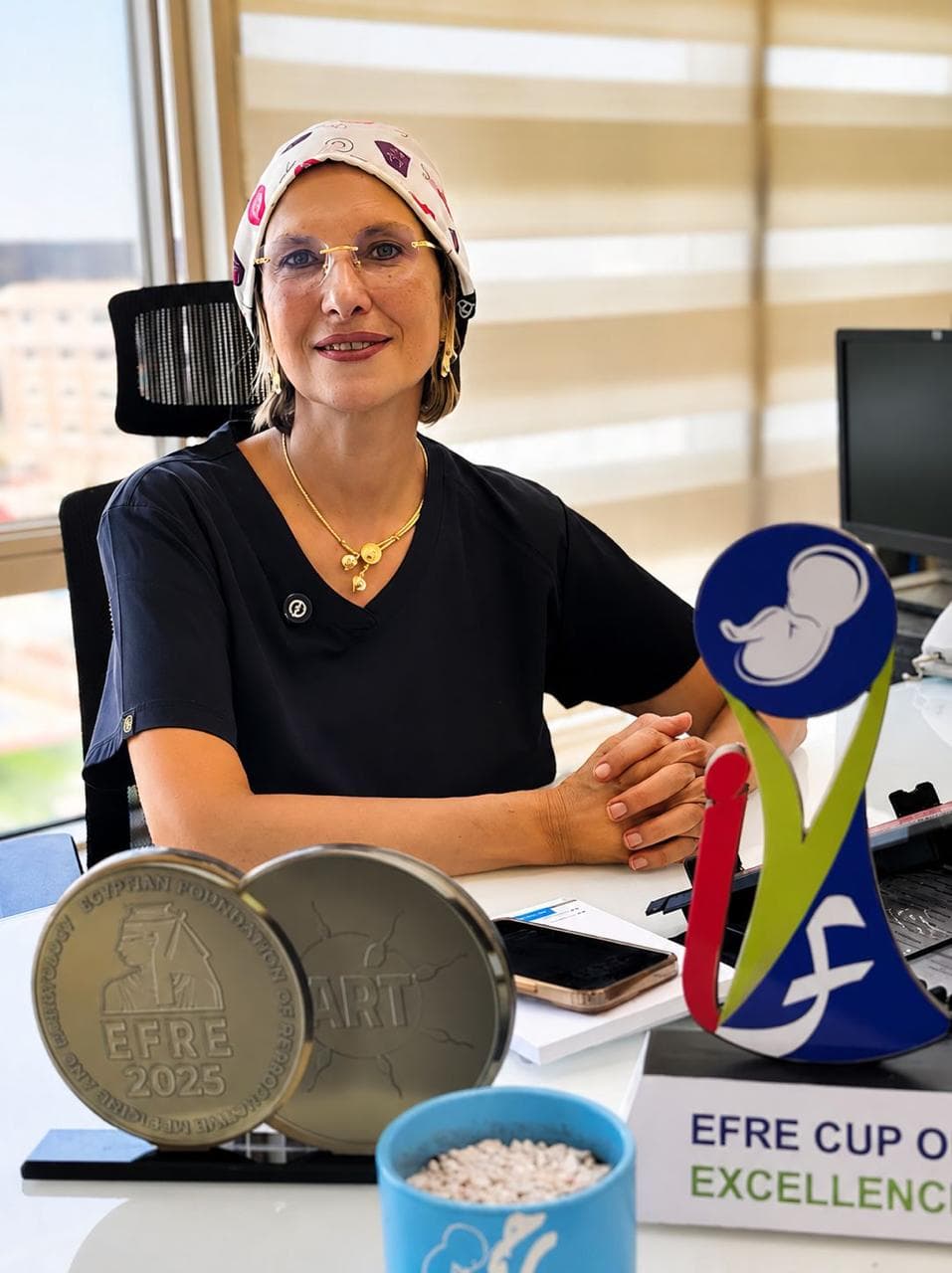
From global expertise to Rahem
In fertility care, real expertise isn't only years in practice or the number of cases treated. It starts with scientific training — exposure to the world's leading medical and research schools, and learning from the scientists who shaped the field.
On 13 November 2013, Prof. Eman A. Elgindy earned her PhD in Reproductive Medicine from Maastricht University in the Netherlands, with the thesis “Long GnRH agonist protocol in IVF: approaches to optimizing treatment outcome” — one of the central questions in fertility treatment: how to improve IVF results by choosing the right protocol for each patient.
Her principal supervisor was Prof. J.L.H. (Hans) Evers of Maastricht University, one of the most prominent figures in reproductive medicine: former Editor-in-Chief of Human Reproduction — one of the field's leading journals — and former Chairman of the European Society of Human Reproduction and Embryology (ESHRE).
Training under a scientist of that stature shapes more than knowledge; it shapes how one thinks: how evidence is weighed, how research is designed and analysed, how results become better clinical decisions — and how every case of delayed conception deserves an individual plan rather than one protocol for everyone.
That training didn't end with the PhD. Prof. Elgindy has stayed closely connected to the international scientific community — through congresses and societies worldwide — bringing the latest in assisted reproduction, embryo transfer, implantation failure and poor ovarian response back to patients in Egypt. That is Rahem's philosophy: the best care starts with the best science, and is complete only when global expertise becomes real care for every patient.
Research focus
- Frozen embryo transfer optimisation and endometrial preparation
- Recurrent implantation failure
- Individualised ovarian stimulation and poor responders
- Fertility preservation in women with cancer
- Luteal phase support
- Ovarian reserve and AMH